Why Audi is now key to Verstappen’s F1 future
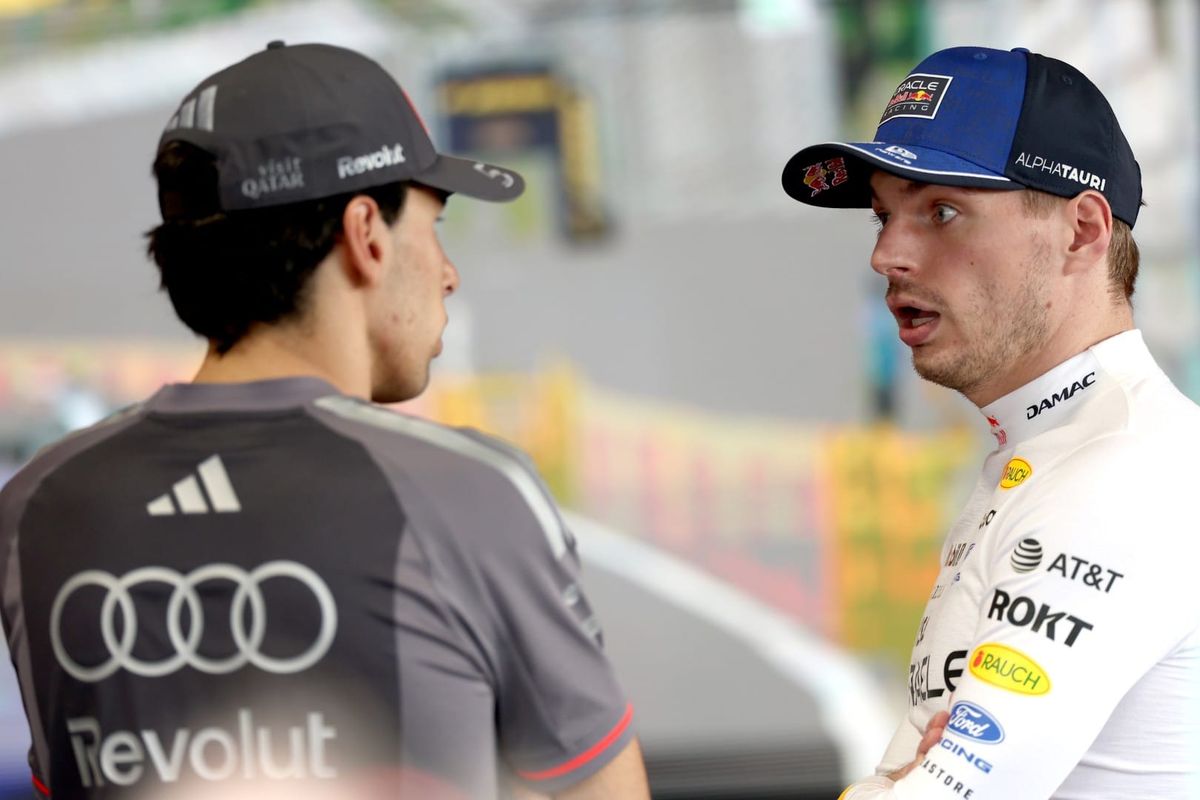
While some in the Formula 1 paddock have viewed Max Verstappen’s threat to quit if the rules are not changed for next year as a political ploy, sources close to him are clear that he is dead serious.
They say that the four-time champion’s comments on Saturday night in Montreal - that it was “not mentally doable” for him to continue driving with the cars as they are - come from the heart.
Sure, Verstappen’s public criticisms of the quirks and characteristics of the current cars may be less frequent than they were at the start of the year. But this is because he just doesn’t see the point of coming off like a broken record and saying the same stuff on repeat for the sake of it.
His message has remained consistent, though – and it was quite telling that he was happy to tell the F1 cameras in Montreal after qualifying exactly what he thinks of F1's rules.
“I mean the whole energy management stuff is just a joke,” he vented. “Yeah, it's super painful at the moment.
“You know, you try to push more. Then you have less energy, it's clipping more, and then you have to use a different gear, so you go slower in the corner but faster in the next straight.
"It has nothing to do with racing for me. It's really, really frustrating.”
Faded unanimity
The recent agreement in principle from teams to make some fundamental changes to the power unit hardware for 2027, to shift the 50/50 power split from combustion and battery towards 60/40, appeared to have given Verstappen optimism that things would become more normal again.
But it became clear over the Canadian GP weekend that paddock politics had ridden roughshod over that unanimity, and left F1 lacking the necessary support needed to vote through changes into the regulations for next year.
This is why a proposal tabled by the FIA has not even got as far as a formal ballot yet - because it is obvious it does not have enough backing right now.
If support fails to materialise and the changes fall by the wayside, then Verstappen will walk.
And, as he made clear also in Montreal, it won’t just be a sabbatical to bide time until a proper reset in 2028. He will be gone.
The super majority
Verstappen’s stance has added some urgency to efforts being led by the FIA and FOM to try to get a proposal in place that can win enough support to get over the line.
For change to get the green light for 2027, it will require backing from four of the six manufacturers - to secure a supermajority in the Power Unit Advisory Committee.
Right now, only Mercedes and Red Bull are in favour. Audi, Ferrari and Cadillac are firmly against for different reasons, while Honda sits somewhere between these two camps.
Audi’s concerns about rushing things through for 2027 relates to costs and technical constraints. It is of the belief that it does not have the resources nor ability to redo a power unit for next year, considering it is new to F1.
Ferrari and Cadillac’s disapproval is more related to the implications of opening up engine development for everyone next year, as that could impact the Additional Development and Upgrade Opportunities (ADUO) catch-up mechanism.
Right now, Ferrari is clearly hoping that it gets granted ADUO - which can help it improve its power unit to close down the gap to Mercedes both this year and into next season.
Take ADUO away, or open up homologation to allow everyone to develop their engines, and that could mean Mercedes not only staying as far ahead as it is now but also potentially stepping further clear.
This is why Ferrari is eager for more time to understand the implication of any hardware change for both 2027 and 2028.
But waiting is not something the FIA has much patience for.
Pressure point
Time is tight to get a deal across the line, as all manufacturers need to get rolling with their 2027 plans immediately if change is coming.
So if a deal is going to happen to get things through next year rather than waiting for 2028, then it needs to be done quickly.
The urgency to get things moving is why FIA single-eater director Nikolas Tombazis was seen marching up and down the paddock in Canada for a series of discussions with manufacturers to try to work out a way to reach some form of consensus.
While there is understood to be a level of frustration within the FIA that the unanimity expressed after Miami evaporated so quickly, pragmatism has taken over and the push now is not to bend over backwards and seek support from everyone – but instead play the numbers game and get the supermajority over the line.
Ferrari seems quite entrenched in its position. Its focus is locked on ADUO and all the implications surrounding that. That is a topic that is going to be hugely complicated and politically complex to unpick. Cadillac appears to be in line with this, too.
Winning those two over seems to be fraught with difficulty, which is why sources suggest that Audi is now central to the deal instead, as that is the manufacturer that is perhaps most amenable to some form of arrangement.
The theory is that if Audi can be convinced, then Honda will quickly fall into line in joining the pro-change camp – especially as it does not seem too wedded to things.
Honda’s trackside general manager Shintaro Orihara said in Canada: “We just respect [the] FIA decision. So we are waiting.”
From Audi’s perspective, an anticipated $10 million extra spending to revamp hardware for 2027 is too much to stomach right now off the back of all the investment it has made to get onto the F1 grid.
But there may be mechanisms available within the constraints of the cost cap, or some tweaking to the rules that do not require a full-scale engine revamp, that can convince Audi to commit to a 2027 package.
What the FIA and F1 are keen to avoid, though, is that next year ends up being just a compromise arrangement and then efforts have to start again to get things fully sorted for 2028. They want one agreed hit in place that stands firm for the duration of this rules set until the V8s arrive by 2031 at the latest.
Political fallout
If Audi and Honda can be won over, joining Mercedes and Red Bull, then Ferrari and Cadillac will be powerless to stop change happening.
That may trigger some major political controversy in the paddock but that may be a smaller problem for F1 than giving up the fight entirely for 2027 and continuing with rules that clearly do not work and could force a superstar like Verstappen to walk.
If a supermajority is secured, Ferrari's hands may even be forced in coming to a table for a compromise deal - as that would be better than it having won no concessions at all.
Red Bull boss Laurent Mekies, whose team would be the biggest loser if the changes do not happen for next year and it loses its best driver, is calm about things – and reckons in the end everyone will see sense.
“When it comes to what matters for the sport, I think at some stage we will all put on the side what we feel it [the change] may or may not do to our relative competitiveness, to do a step in the right direction for the sport,” he said. “I think ultimately we'll get to that point.”
All eyes now then on what the FIA does to win that crucial Audi backing.