What was behind Russell's radio rant - and why it wasn't broadcast live
An angry radio message from George Russell after his lap one exit from Formula 1's Belgian Grand Prix became a post-race talking point on two fronts.
First, for what he said, and secondly for how his words got out because they had not been broadcast on the normal international television and onboard feeds.
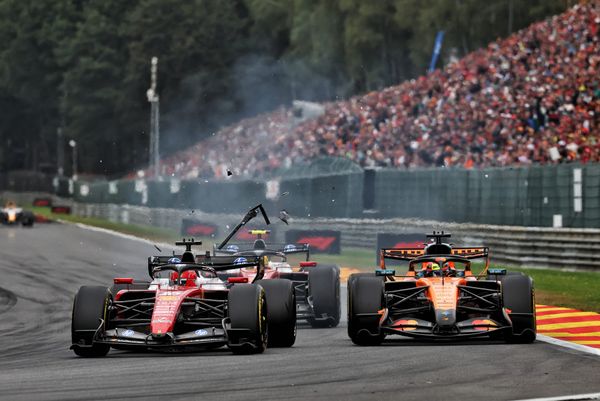
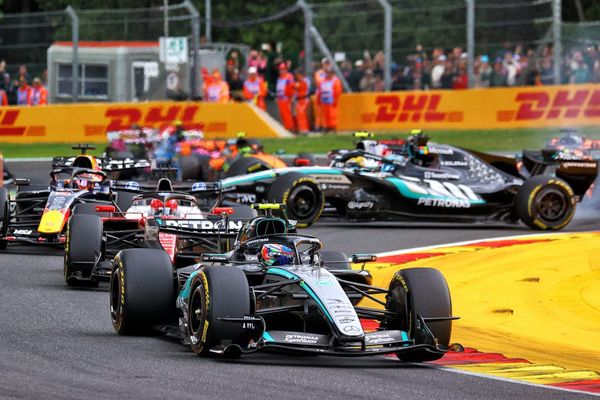
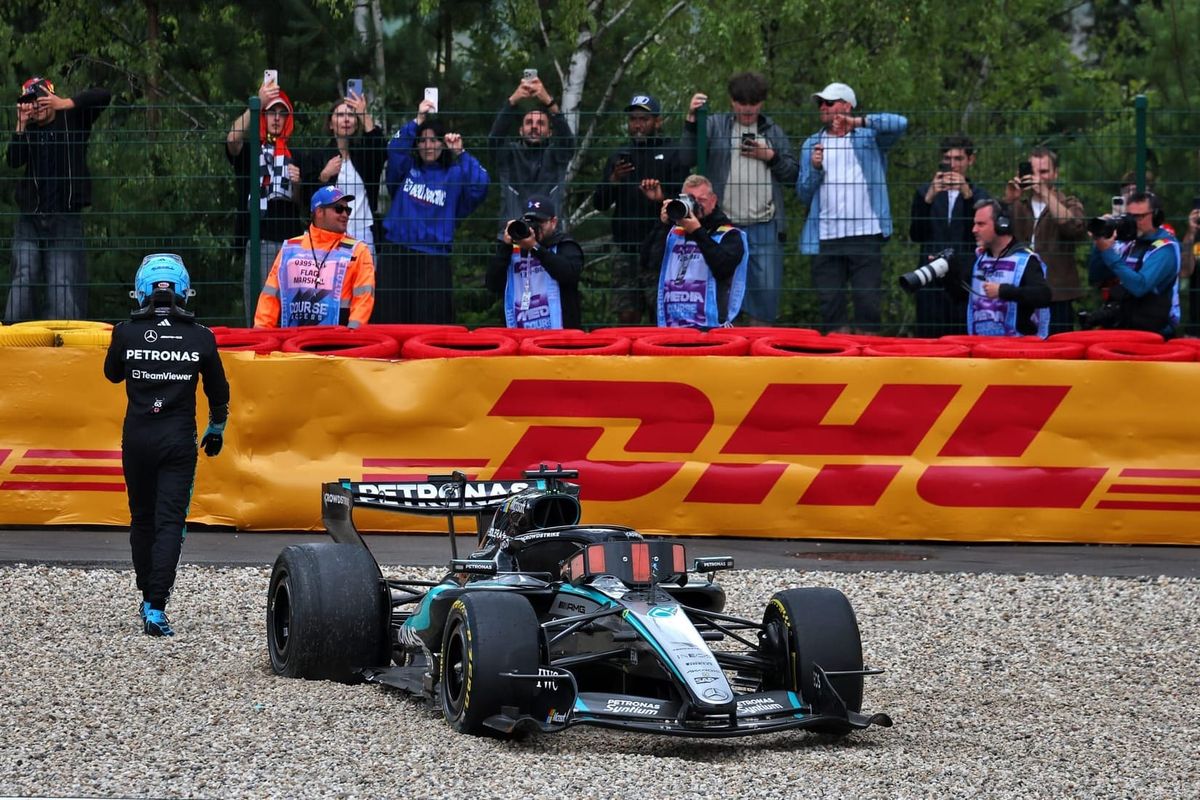
Russell was spun out on the opening lap of the Spa-Francorchamps race in a collision with Lewis Hamilton at Les Combes.
While Hamilton was penalised by the FIA stewards for his part in the crash, Russell said the real catalyst for the incident lay in him having been left a sitting duck on the run up to the corner because his Mercedes lacked deployment.
While his rivals enjoyed a speed boost down the Kemmel Straight, Russell found himself without the power he hoped for – losing track position and getting swallowed up by the cars behind.
Russell's onboard camera as he sat in the gravel trap at Les Combes showed some animated hand movements that suggested he was talking – but the international feed and F1 TV's own onboard feed were silent as they did not register any radio message.
However, German TV coverage – which was broadcast on F1 TV's own language channel - later revealed the angry words that Russell had uttered as his frustrations boiled over.
A few minutes after Russell's crash, and just before the safety car restart, it replayed his radio message.
"I'm out," declared Russell. "What the f*** happened with the SoC [State of Charge] down the straight?
"I had no f***ing battery down the straight! Guys, unacceptable. Un-f***ing-acceptable this whole weekend."
Russell's comments referenced the lack of deployment both on the opening lap and that he had suffered throughout a weekend where his top speed had been down on team-mate Kimi Antonelli.
What happened after the first corner
Russell's complaints about no battery related to him lacking deployment as he exited Raidillon on the long run up to Les Combes.
Mercedes team principal Toto Wolff claimed that "all Mercedes cars" had suffered a lack of energy out of the opening corner La Source, although there was no initial explanation at the time about what had triggered this.
The Race understands that the cause appears to have been some sort of software error that prevented the cars from unleashing maximum power for top speed down the straight.
The issue was not related to the kind of problems that Mercedes had suffered at the start of the season when its cars had hit recharge limits on the formation lap so had been unable to fill their batteries enough.
On the grid, Russell had been assured that his state of charge had looked in perfect shape.
Analysis of the telemetry data from Russell and Antonelli's cars show they both encountered problems once they came out of La Source, though, as shown below on the graph from F1 TEL.
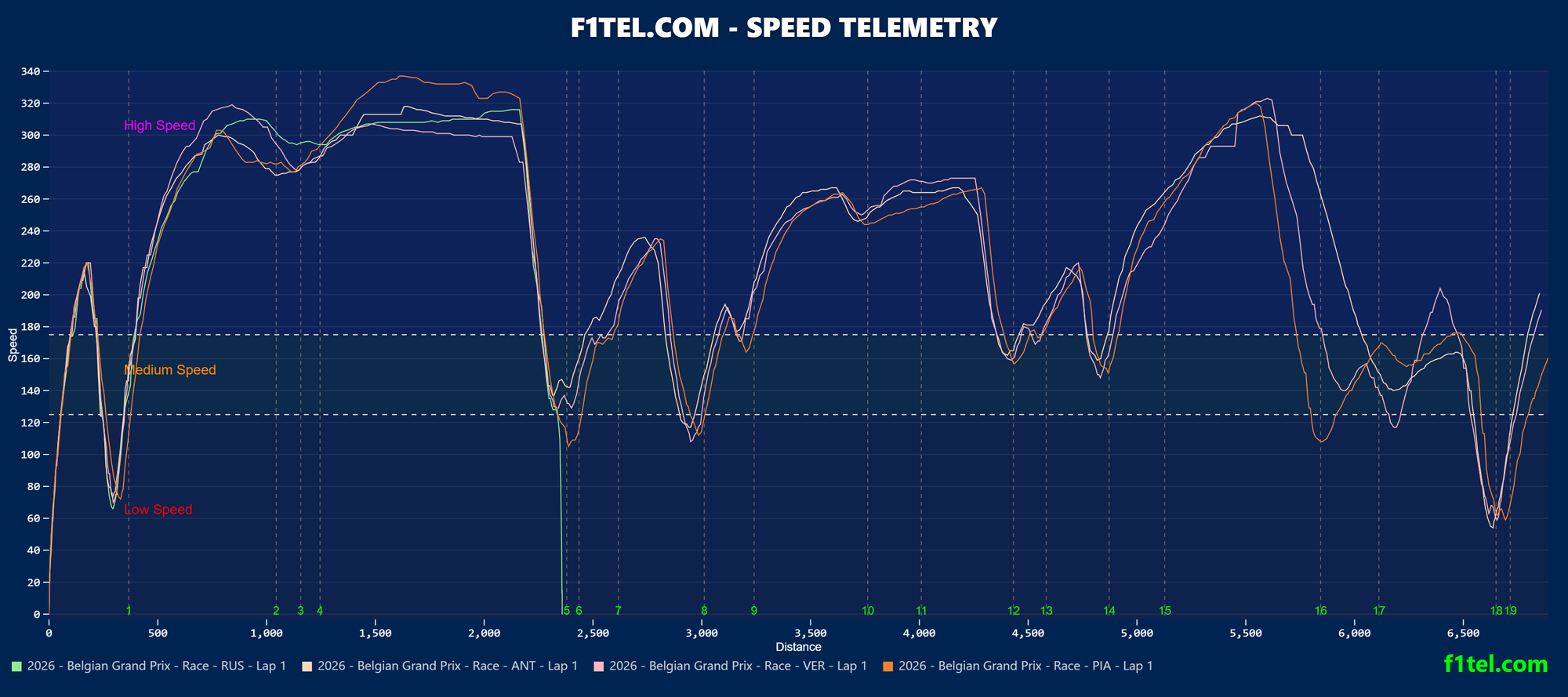
On the way out of first corner La Source, Antonelli's car stopped accelerating around the 300km/h (186mph) area as they headed to Eau Rouge – which allowed Max Verstappen to pass him.
Russell's pace here had already shown some signs of trailing off as he was 10km/h (6mph) slower than his team-mate, before he enjoyed a lift in speed from 277km/h (172mph) that meant he entered Eau Rouge at 310km/h (193mph) – fastest out of the frontrunners.
On the way out of Raidillon, however, Rusell ran into much bigger trouble.
Despite being full on the throttle and having followed a request from his engineer to use the boost button on the corner exit, his speed capped at 308km/h (191mph) for several seconds,
It then climbed steadily up to 315km/h (196mph) at the entry to Les Combes to pull him back into the pack of cars ahead, as he aimed to regain positions.
Antonelli appeared to run in two speed stages down the Kemmel Straight.
He was first capped momentarily at 313km/h (195mph), and then later at 318km/h (198mph), but this was enough to allow him to draft past Verstappen - who was low on power and had been steadily drifting down from a peak of 306km/h (190mph).
McLaren's Oscar Piastri had been slow out of La Source – up to 10km/h (6mph) adrift of Antonelli before Eau Rouge – but appears to have had good deployment up to Les Combes as he got up to 337km/h (209mph) before he started to derate.
The telemetry data of Ferrari does not appear reliable enough on the opening lap to judge exactly how Lewis Hamilton and Charles Leclerc were doing against Mercedes - but both clearly enjoyed good deployment.
The broadcast intrigue
Russell's radio message highlighted his anger at both what happened on lap one as well as throughout the entire Belgian weekend.
What prompted some intrigue though is why that radio message was muted in the official broadcast – and only appeared on the German feed.
This has triggered some conspiracy theories about a potential deliberate censorship move over deployment criticisms, and even that the radio message that emerged was AI-generated and not real.
The Race has confirmed that any suggestion about it being a fake are incorrect, with the radio message indeed being real.
In terms of why it did not appear on the broadcast nor F1 TV's radio channels, The Race understands it was muted because of the bad language that Russell used.
As part of a move that it is understood former managing director of motorsport Ross Brawn put in place when at F1 to save drivers from themselves, any extremely angry messages and bad language broadcast over team radio do get filtered out.
All radio messages get listened through by a team of eight editors and producers at F1's Biggin Hill broadcast centre before being committed to being played by F1.
This allows any troublesome messages to be filtered out as F1 primarily puts radio messages into three tiers: fully transcribed with audio; audio-only; and text-only.
This process explains why there is often an offset of up to 15 seconds between the live images and the radio messages being shown.
Sometimes on-the-edge messages will get broadcast with the addition of a bleep to hide any swear words.
There are occasions, however, where the radio message is so emotional or expletive laden that it never makes the broadcast.
Speaking during an event at Biggin Hill last year, F1's director of broadcast and media Dean Locke explained that there was a duty to sometimes not broadcast radio messages at all if it was felt they would compromise drivers.
"There is a responsibility," he said. "Is there something they may regret? We have to sort of protect them a little bit from that.
"So we have a function that we can deal with that: mute it, bleep it occasionally."
Russell's choice language after his Spa crash is understood to have led F1's editors to decide that it should not be broadcast – either in full or even with bleeps.
So that is why it was muted on the international feed and F1 TV boards.
However, it is understood that some television channels can get direct access to unfiltered radio messages and are not just beholden to what makes the official internal broadcast.
With 22 drivers and engineers all talking to themselves for two hours, finding radio messages that are muted so they do not make the final cut is far from simple, though.
But it could be possible that Russell's incident was such an obvious one to listen in to, that his in-car rant was straightforward to find, which is how the German channels uncovered it and committed to broadcasting it.