Gary Anderson: The real reason Red Bull has a high-speed crash problem
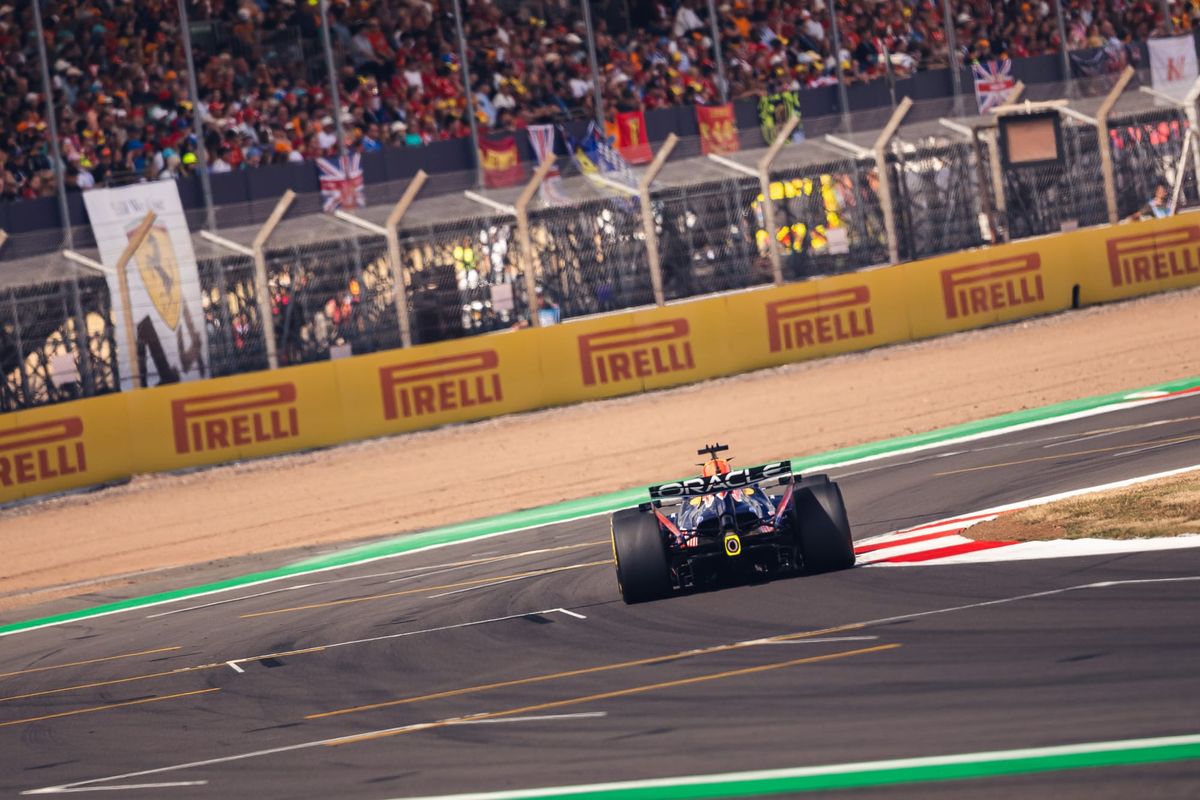
Now that the FIA is looking into the style of rear wings used by Red Bull and Ferrari, analysing the data to understand the differences between the conventional DRS-style larger slot gap concept and the flip-over versions, it’s time to separate the fact from the fiction as I see it.
Red Bull’s flip-over rear wing isn’t the main problem causing Max Verstappen’s offs. Instead, it’s about the working window that Red Bull is designing its car to operate in aerodynamically.
That’s not to say that the way the rear wing closes isn’t increasing the problem, albeit only fractionally, but simply that it isn’t the origin. That lies in how it’s behaving aerodynamically in a transient condition, so what happens in those last few milliseconds between the wing being more or less mechanically shut and the airflow doing what you want it to do, which is attach to the wing.
You open the rear wing to get rid of drag. Unfortunately, with that reduction in drag, downforce disappears as well, but it gives you more straightline speed. Then you close it to maximise downforce and get the best cornering grip possible. That happens automatically when the driver lifts the throttle, hits the brake pedal or presses the button to shut the wing.
We’ve seen in the past with DRS that drivers have had problems with airflow reattachment, so they would press the button a little bit earlier, just before braking, to make sure the wing was working again before they turned in. That’s something you can do to tackle the problem, but it doesn’t solve it, and the temptation is to press it later and later with each lap.
Although the exact cause of the problem that caused the Austria qualifying crash and the one in the race at Silverstone might be fractionally different, it is basically the same problem. The rear wing shuts mechanically, and from the outside it looks as though everything has happened as it should. But that does not mean the airflow has reattached. That is the critical point.
Putting some rough maths to this closing procedure, we get the following: The regulations require that the wings go from one mechanical position to another in less than 0.4 seconds.
If we assume that the normal system - as the DRS used to do by simply opening up the slot gap, which is what the majority of the grid uses - rotates 45 degrees, then that means that the wing rotates one degree in 0.0088 seconds.
If we assume that the Red Bull and the Ferrari systems rotate 225 degrees from fully open to fully closed, then their systems rotate one degree in 0.0017 seconds.
I believe that it is the last five degrees of slot gap closure that is critical to airflow reattachment. This means that with the normal larger slot gap opening system, it will take 0.044 seconds to travel those five degrees, while for the Red Bull and Ferrari system, for that same final five degrees rotation, it will only take 0.0085 seconds. This means that one system is required to travel five times faster than the other to comply with the regulations.
If you look at it the other way around, then with the same hydraulic pressure and actuator size, etc the DRS-style system would close five times faster than the Red Bull or Ferrari system. I'm pretty sure the actual closing rate lies somewhere between those two extremes.
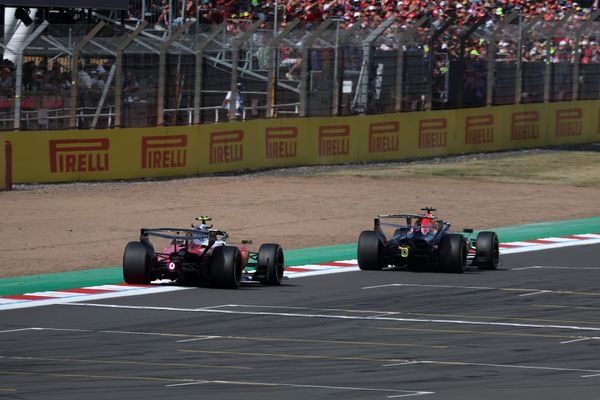
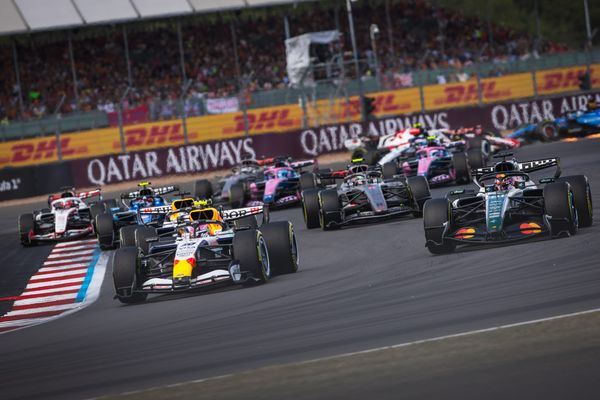
Turn 9 in Austria, where Verstappen crashed in qualifying, and into Stowe at Silverstone, where he spun into the gravel in the race, are basically very fast corners with high-speed entries, with a minimal braking requirement of let’s say 0.5 seconds.
This means that with the normal larger slot gap opening, you have 0.4 seconds from hitting the brake pedal, which closes the wing, giving you all of that 0.4 seconds plus another 0.1 seconds of wing stability before you turn the steering wheel into the corner. And with the flap assembly, even in the open position, it would still be creating a very small amount of positive downforce. This should be easily long enough for the airflow to fully reattach.
For Red Bull and Ferrari, if you are braking at the same point and turning the steering wheel with relatively the same delay after braking, then that would mean you would be turning the steering wheel more or less immediately the rear wing has closed. Remember it has to rotate 180 degrees before it gets to the same position as the other wing designs start to close from, and that has to happen before any positive airflow attachment starts to take place. This gives no time for airflow stability and/or reattachment.
When the wing is open, the objective is to minimise drag. When it is closed, the objective is to maximise downforce. You work the aero surfaces as hard as physically possible when closed, because that means you get the maximum downforce out of it. But if you work those surfaces too hard, the airflow reattachment on the flaps becomes more dramatic and also more critical, and more critical to the influence of turbulence.
Yes, you could go back to a DRS-style system, and as with the other teams, that would give the airflow more time to reattach before the steering input. Mechanically, the wing would effectively be shut earlier. But in all of that, you are losing performance; we are only talking about thousandths of a second, but we are always trading something.
The big question is what you do about it. Do you go back to a wing that is not as efficient? Do you increase the speed of the rear wing closing? Do you open the slot gap fractionally? Do you reduce the angle of the flaps fractionally so it is not as hard to reattach the airflow? There are many ways of doing it, but what you have to find is the best compromise.
If it were me going to Spa, I would be looking very closely at the speed of the rear wing closing and, somehow, the detail of how the airflow attaches. That is very difficult because it is a transient condition. It is those last five degrees of wing angle, when the slot gap is going from maybe 20 millimetres open to 12 millimetres, where you want the flow attachment to start.
We have seen rear wings close hundreds, probably thousands, of times during these races, and basically they all function pretty well except for Verstappen on two occasions. So Red Bull needs to look at its own design and at how far it is pushing the limits.
I wouldn’t be surprised if this same problem were also contributing to the lack of consistent balance that Verstappen is suffering from from time to time. For example, on low fuel in qualifying, the first thing the driver does is brake later - ie the Austria crash - while at Silverstone on low-fuel late in the race and running third, he probably also got a little over-enthusiastic on the entry to Stowe.
Red Bull, by its own admission, has a problem. To understand this, it needs to look at that very closely in CFD, with a lot of different wing angles, and then look at the theoretical transient effect between them.
The key thing is how close to the limit Red Bull is actually running the rear wing, as in, are you trying to work that surface a bit too hard. To test this, you take the rear wing assembly you have now, either in the windtunnel or in CFD and you increase the angle of the flap assembly in small increments, say half a degree at a time, until you get to the point where it stalls.
If you only have say only one degree of margin before it stalls, then you are pushing it far too near the limit. In that case, you reduce the flap angle relative to the mainplane by a degree or two. Yes, you lose a little bit of downforce, but you gain a bigger working window where the flow will reattach, or at least has time to reattach before you need it.
That is what I suspect this comes down to. Red Bull is working the aero surfaces on the rear wing too hard.
Red Bull has always pushed the limits to the maximum possible, and that is part of why it has been so successful. But you still need to give the car, and every component on it, a working window.
Right now, that working window is just a little bit too small. And perhaps the risk of pushing it too far is a justification for the FIA to outlaw it.