What's behind McLaren's sudden Miami GP slump
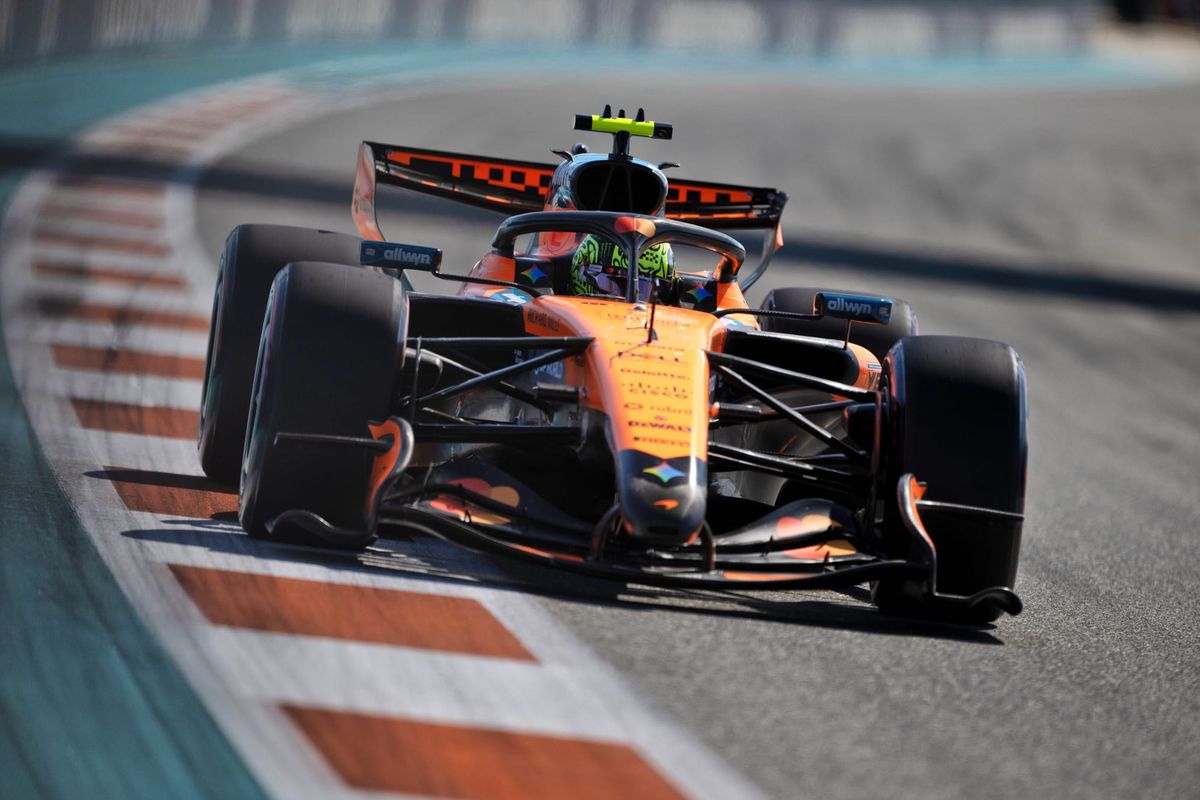
After McLaren's Miami Grand Prix sprint pole and a 1-2 finish in Saturday's race, that Lando Norris and Oscar Piastri fell back in qualifying for the main event was a bit of a mystery.
And it wasn't just the drop of positions that stood out, it was that McLaren had actually got slower over 24 hours.
Main rivals Red Bull, Ferrari and Mercedes all made jumps of 0.3-0.5 seconds from sprint qualifying to main qualifying, but McLaren's cars ended up losing a similar amount of time.
It left Norris down in fourth place for Sunday's race, with Piastri three places further back.
The shifting patterns of form owed almost everything to deployment tactics and push lap preparation, especially with the other teams having shifted their management strategies closer to what McLaren had done on Friday.
McLaren had unlocked its stunning sprint qualifying form by using more energy between Turns 3-4, whereas Mercedes and others had saved it for the main straights but then found it had not delivered much benefit.
So as everyone converged on Saturday on where to deploy, it followed that laptimes would get closer too.
But that did not explain everything, because McLaren losing pace was about a lot more than simply the choice of where each team decided to use power.
As McLaren team principal Andrea Stella hinted, its situation was much more the consequence of some sensitivities that are a peculiarity of the current generation of power units.
"It's not simply where you deploy your energy, but it's also how the deployment of your energy is sensitive to some other things that happen, for instance, in part-throttle," he said during his Saturday evening media briefing.
"I don't want to disclose too much here, but I want to give you the sense that it shouldn't be seen in classical terms of where am I spending my energy.
"It's much more interlaced between the electrical behaviour and the ICE [internal combustion engine] behaviour itself. Sorry for being cryptic, but that's what we deal with."
The environmental factors
What Stella was referring to was how McLaren's deployment strategy appeared to have been derailed by the smallest of outside influences.
For example, head winds can mean cars burn through extra energy on the straights, which then influences car systems that try to alter energy management over the rest of the lap to counter the loss but end up not being perfect.
Stella added: "It gets pretty tricky in terms of optimisation."
Even starting the lap in Miami has proved to be quite tricky, especially because of the long back straight where drivers have battled on preparation laps to get their battery fully charged for it to unleash everything across the line.
This requires drivers juggling their speed, balancing throttle levels to stay below a 60% limit that guarantees not unnecessarily burning through battery energy, and then making sure to not hit the recharge limit for the final slow down.
Grand prix polesitter Kimi Antonelli had fallen foul of not nailing things fully in sprint qualifying, starting his final SQ3 effort without his battery pack fully charged, which then cost him speed into Turn 1.
Norris's final Q3 effort was derailed by a similar thing.
"I started my final lap with just less deployment for some reason," he said. "It just didn't go to the full pack, so I was screwed from the off.
"So it was definitely not as clean a run from ourselves, and we need to understand why."
Piastri too talked of unintended consequences that play out when one subtle shift - such as a change in deployment strategy - can trigger random events such as getting an unexpected super clip at Turn 7 on his second Q3 run.
"We tried to change a few things with our deployment, and it didn't quite do what we hoped," he said. "And then we were trying to undo that basically.
"We tried a few tweaks, but there's a lot of rules and you change one thing, you run into a different kind of problem."
Random shifts
The swings of form in Miami - with Red Bull nailing it to get Max Verstappen on the front row and McLaren falling back - is perhaps the ultimate proof that small energy management details can have a big influence in F1 right now.
Piastri said: "It just goes to show at the moment that things are very random depending on who gets it right, who gets it wrong. I think we were probably in the category of getting it wrong.
"And when you get it wrong, it's not the difference of a tenth or two, it's sometimes half a second."
And that amounts to a degree of influence and "a level of sensitivity to the behaviour of the power unit" that Stella reckoned "we are not used to, probably ever, in the history of F1".