Gary Anderson's verdict on a major 2026 development battle
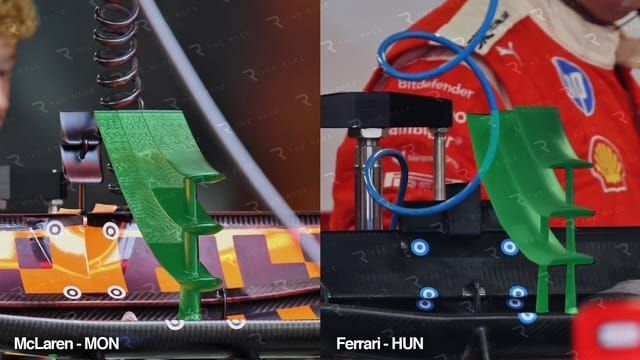
I’m surprised more teams didn’t appear in Hungary with the Monaco rear wing add-on (in green above) that we saw earlier in the season.
Although the Hungaroring is a bit faster, the long corners and likely high temperatures mean that downforce is key to keeping the tyres alive for longer, and with drag not such a big penalty here, it’s a chance to bolt on some less efficient downforce.
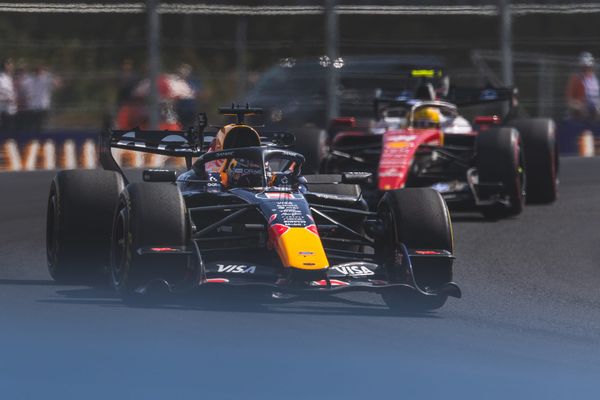
Ferrari made good use of its copy of the McLaren Monaco version, which, together with a few invisible modifications to the flip-flop wing that have been successful, seemed to suit its package, even if the end result underdelivered.
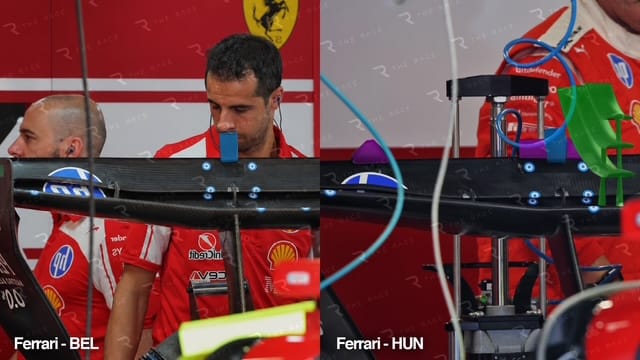
You can see the add-ons. The three-element upper winglet (highlighted in green) acts as an airflow turning vane to set up the airflow direction that is being pulled up around the undersurface of the rear wing.
The rear flap extensions (highlighted in purple above) optimise the chord length available in the area of the active wing mechanism and the flap supports.
You can see the added winglet structure is very similar to what McLaren ran in Monaco.
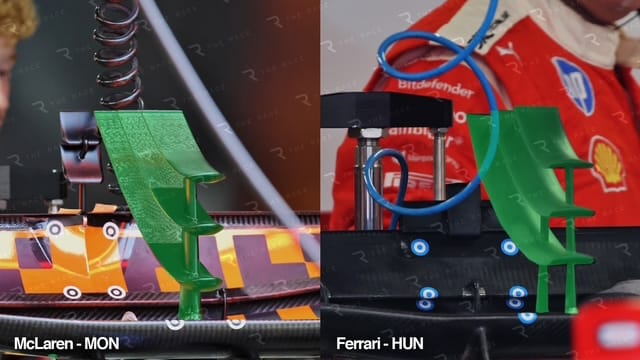
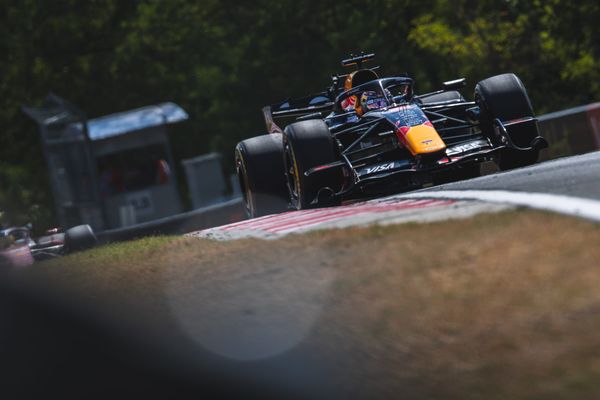
As for Red Bull, it had to carry out some serious modifications to its version of the flip-flop rear wing system. It had a couple of races where Verstappen either went off or crashed due to the airflow not re-attaching quickly enough when the wing was closed from straight mode to cornering mode.
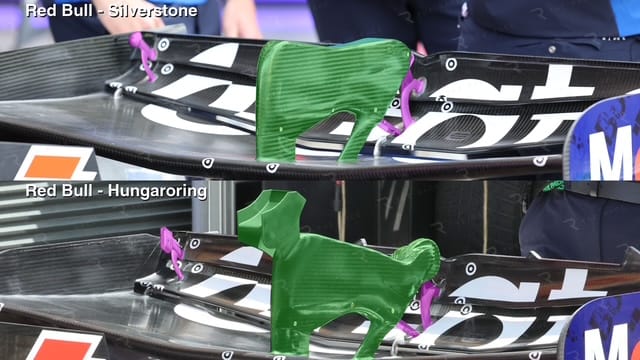
The team said this was caused by a mechanical problem, and you can see some differences in the profiling of the active wing mechanism shroud.
Also, a small turning vane has been added on the leading upper corner of that shroud. This is small relative to what Ferrari has, but still attempting to achieve the same turning moment in the airflow.
You can also see the small V-shaped cutout on the trailing edge of the upper flap. This is positioned just behind that actuator and its shroud.
The reason for this is that the actuator and its shroud will affect the airflow in that area and reduce its velocity.
This, in turn, will affect the assistance that airflow velocity will have on the airflow on the undersurface of the wing, potentially leading to flow separation on the underside.
If you have a small pocket of airflow separation, it very quickly gets much bigger as the airflow around it is already highly stressed.
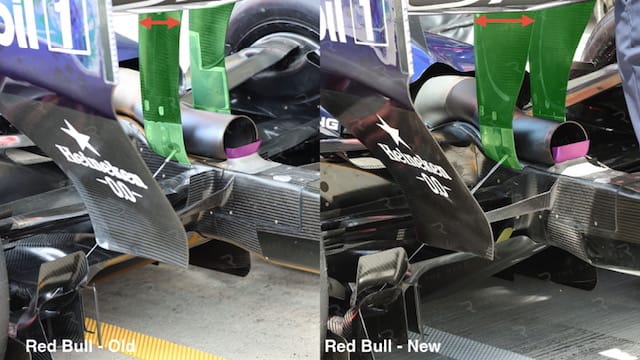
Red Bull has also altered the profile of the wing support pillars as they are now longer cord where they attach to the underside of the rear wing. So basically a more sympathetic intersection, which will reduce the risk of airflow separation in that area.
As we have seen over previous seasons, you would use a horseshoe-style wing pillar system mounting the wing to the pillars on the top surface, which is less critical to airflow separation - that is, if the rules allowed it. This would mean that the critical airflow on the undersurface wasn’t affected by the pillar-to-undersurface intersection.
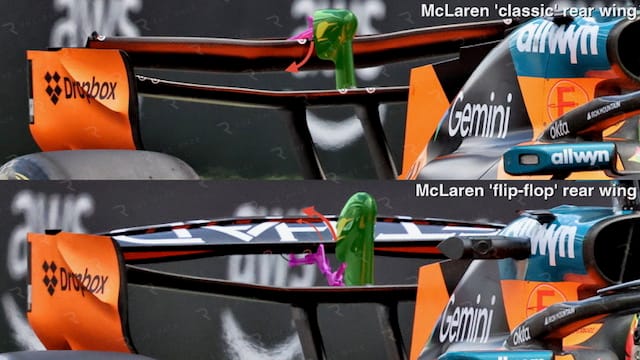
McLaren also tested its version of the flip-flop rear wing in Hungary, but didn't race it. However, the team suggested it was very happy with its potential.
When it comes to McLaren, Ferrari and Red Bull’s versions of the flip-flop rear wings, that features the flap assembly rotating upside down and, in turn, backwards, the airflow over the flap surfaces when the wing is open is actually travelling backwards relative to its design criteria and (red arrows above) to its normal flow direction.
When the flaps are shut for corner mode, that flow has to be stalled and then reversed before you could say it has fully reattached.
With the more standard DRS-concept version, the flaps are actually still producing some downforce, even if it’s a small amount.
More importantly, the airflow on the flap surface is heading in the correct direction to what it will be when the wing is closed.
That potentially means a little less drag reduction, but also a faster and more consistent full airflow reattachment.
Unless you are 100% confident of that instant airflow reattachment on the rear wing, you could very easily lose more than you gain by going to the flip-flop system. To find this confidence and consistency, you need track testing in various different track conditions; this reattachment can very easily be influenced by running in traffic, turbulence, air density, temperature, wind conditions and direction.
So these are the decisions that have to be made; the question is, does the advantage outweigh the risk?
For me, if I were making that decision at the moment, the evidence I would have at the moment is no better than 50/50.